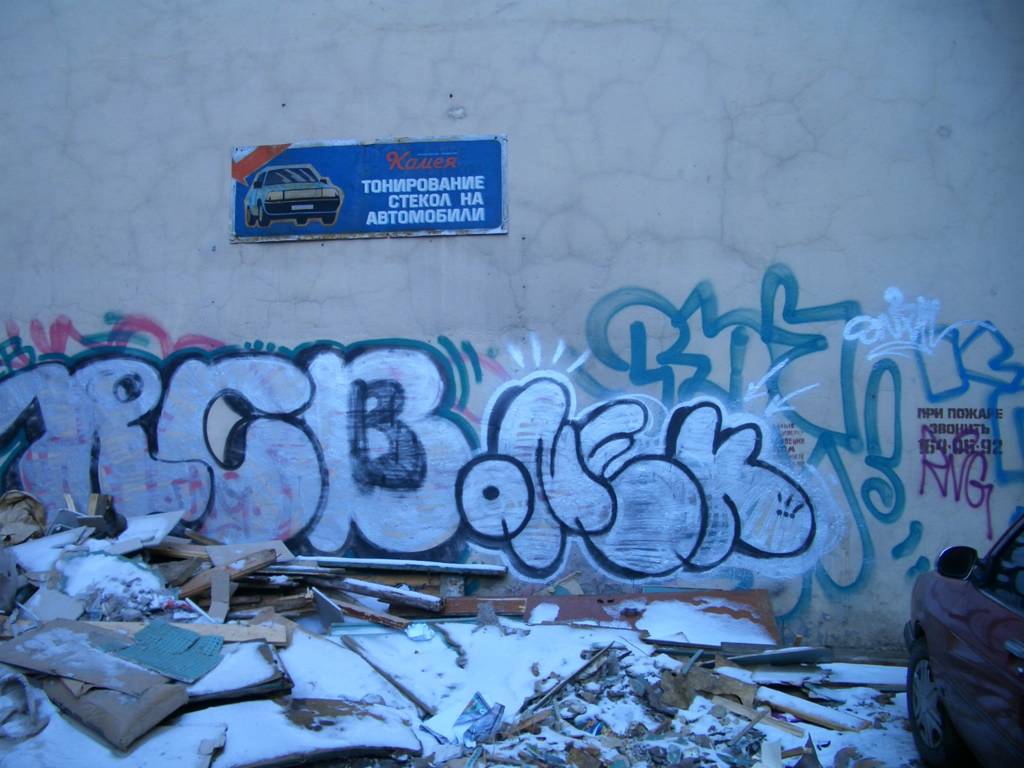
A photoblog with pictures I've taken of graffiti and street art in Moscow (and anywhere else I happen to travel).

Friday, March 25, 2005

Moscow stencil graf

Earlier I posted a bunch of stencil graffiti, principally from St. Petersburg - I haven't really seen much intelligent stencil graf in Moscow. Fortunately, Chris "Two-Zero," a fellow expat in Moscow who maintains a blog called Cyber-generation, saw this new project and was generous enough to share with me a bunch of pictures he's taken of stencil graffiti in downtown Moscow. Thanks, Chris!

None of the pictures in this post are mine, but I am pleased to be able to share them:
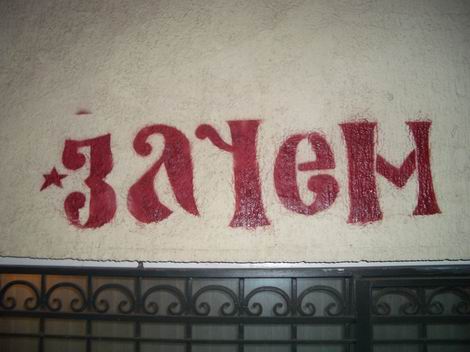

My favorite writer
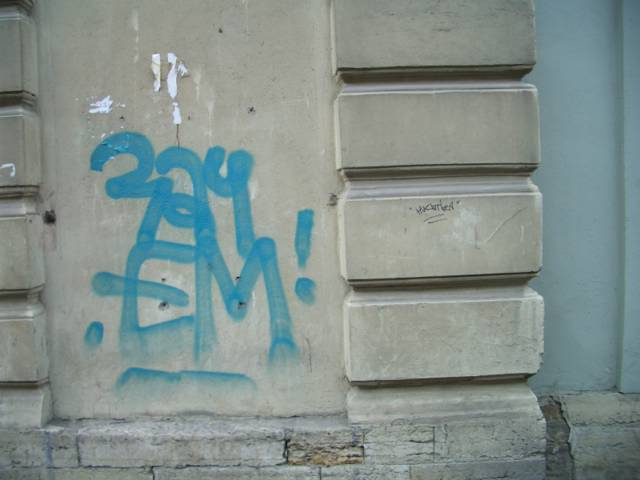
Zachem, in stencil form.


CinePhantom.
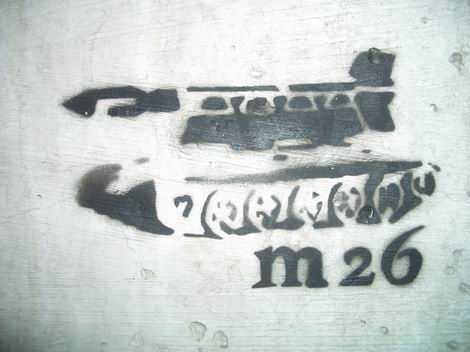

M26 - this appears to be a reference to some sort of weaponry.


M26 - they have more than one stencil, it seems.


"Love ready" - and popping out of the toaster.
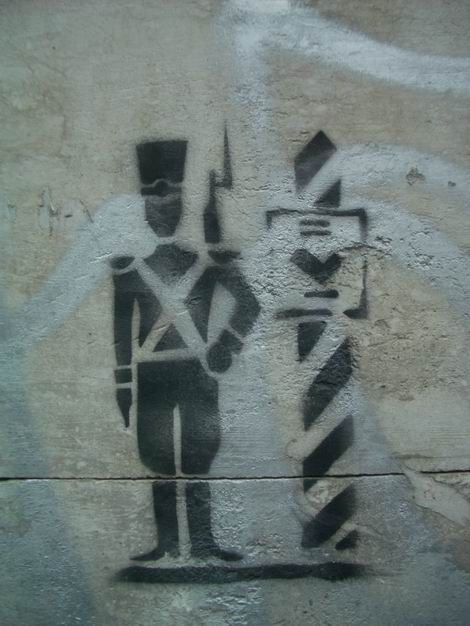

Soldier - note the check mark on the sign, which is similar to the "V" in "Love ready" above - probably designed by the same person.
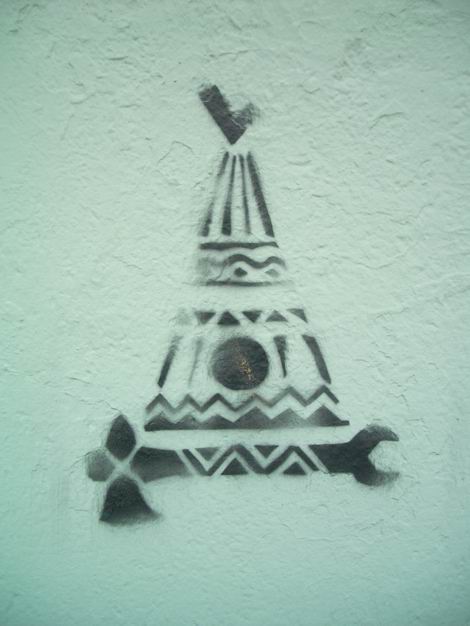

Tepee with strange implement at the bottom - and a familiar check-mark at the top.


The lettering at the bottom appears to say "СМОТРИ," or "LOOK" in Russian.


Hatching insect - cool.
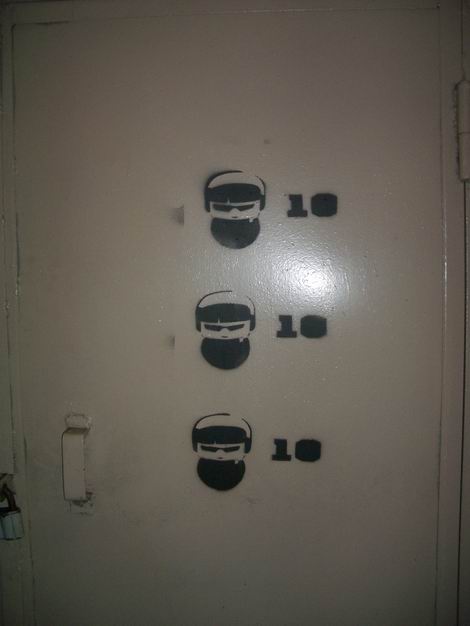

3 X 10.

Labels: , ,

Why am I doing this?

Some might see graffiti and street art as just more of the visual static created by a big city - like billboard ads, puddles of filth, or plastic bags spiraling in the wind, something that's there but not deserving of too much attention. But I'm not one of those people. And so I've been photographing tags and other graffiti around Moscow. If I see something I like, I try to photograph it immediately, because graffiti is often erased or painted over pretty quickly. The non-permanence of graffiti is one of the reasons why it isn't considered "art" by many; for me, it's a major reason to photograph it when I see it.


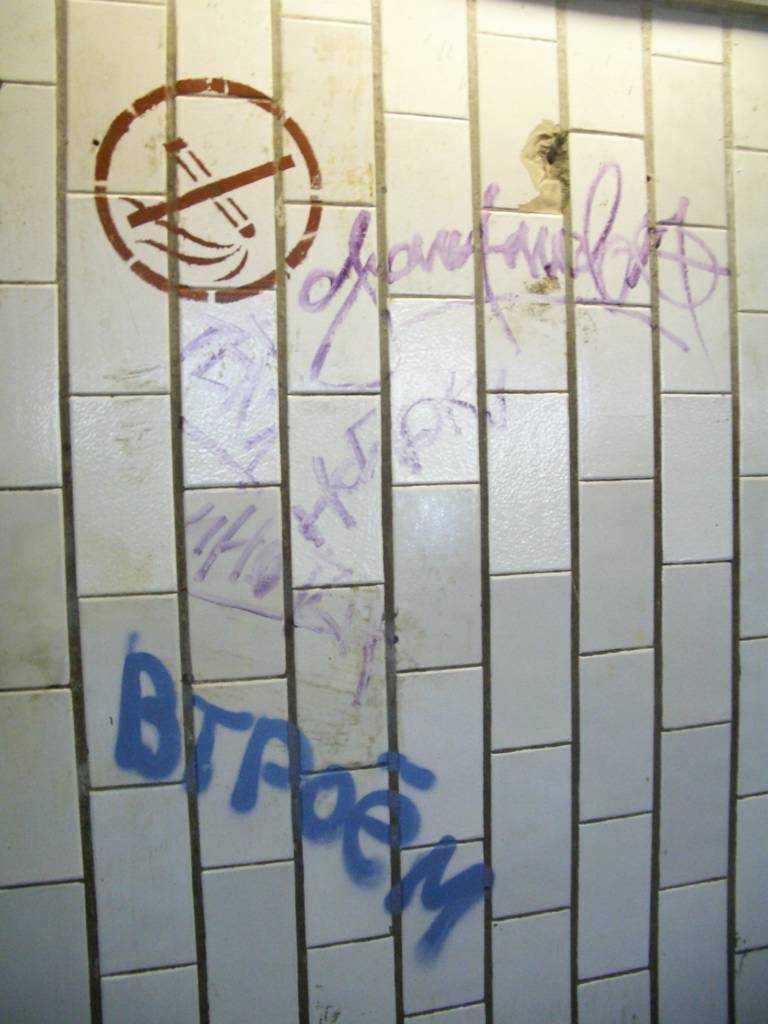
Vtroyom (втроём - this word has no exact translation,
but it refers to three items or people existing or acting
together) graffito by the exit to Tverskaya St. from the
passage underneath Pushkin Square, 6:41pm, Feb. 23.


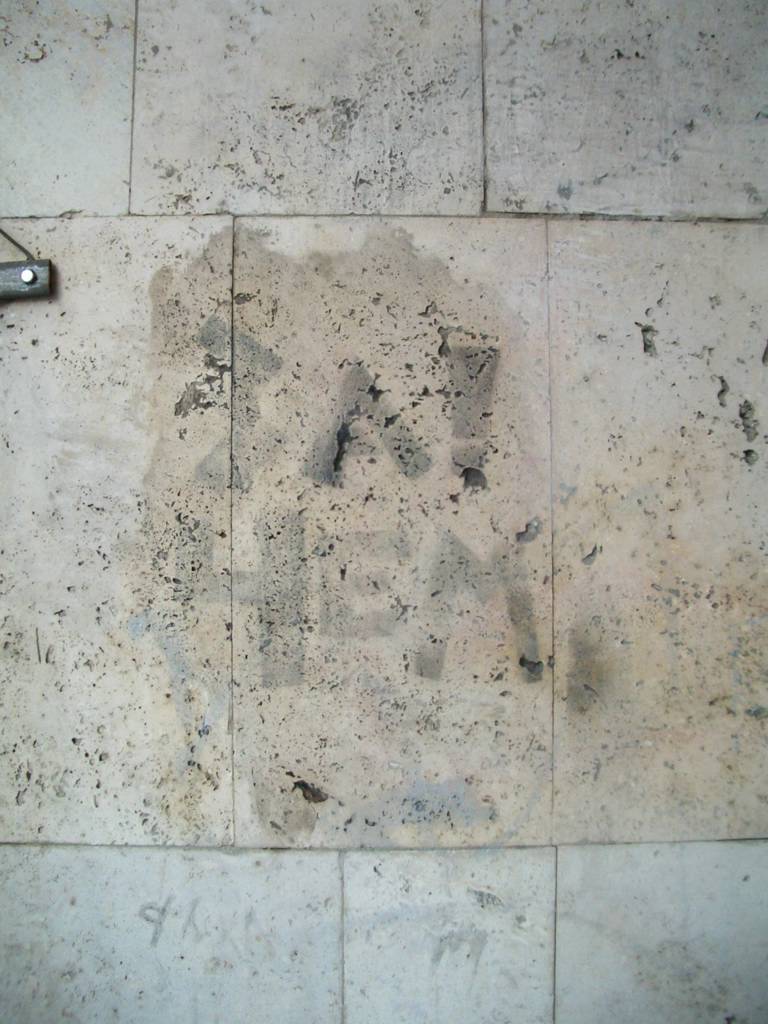
Vtroyom graffito in the Pushkin Sq. underpass (near the exit to the
Pushkin statue), 5:01pm, Feb. 23.

In the case of the Vtroyom tags, days later there were only blurry spots on the tile walls marking the places where they had been.


Graffiti on theater poster display in the Pushkin Sq. underpass, 8:39am, Feb. 26.

These were also gone within less than a week; there were visible marks on the plexiglass where the tags had been scraped off.

Sometimes it's harder to eradicate a tag:


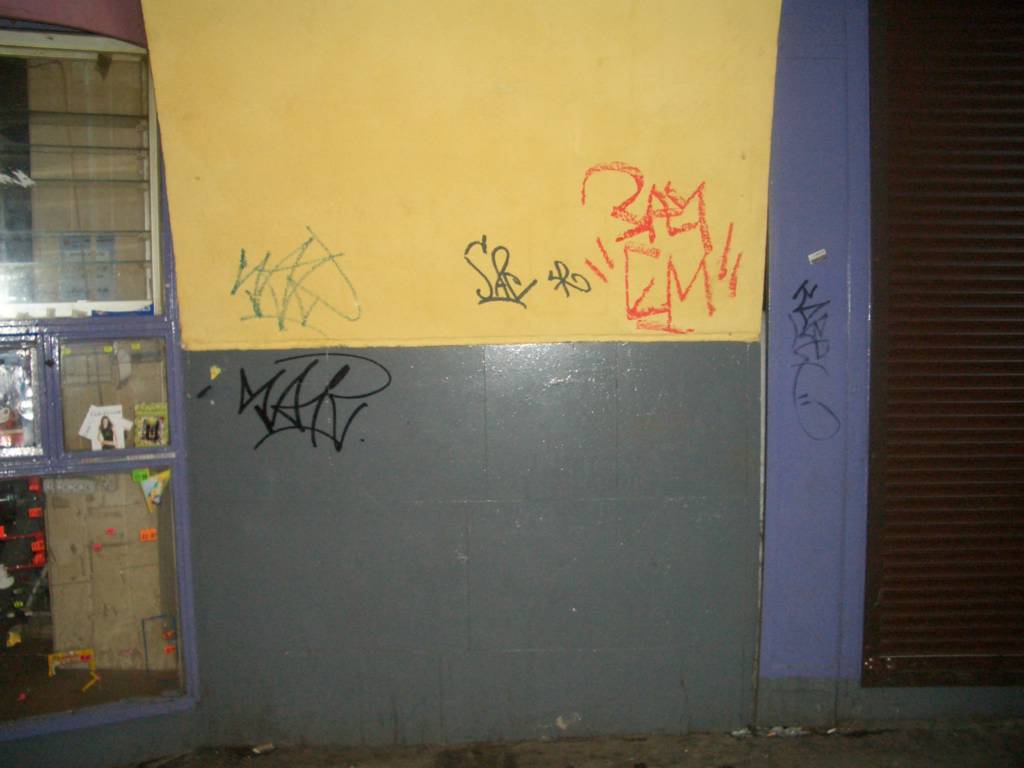
Not-quite-erased Zachem tag on the outside wall of the
Kinomir movie theater, Nastas'inskii pereulok, 5:05pm,
March 8.


Zachem painted over on Malaya Nikitskaya St., 2:23pm, Feb. 10.

Other times, the "graffiti abatement" specialists - or perhaps just property owners who want a clean storefront - are more successful:

Traces of graffiti, Pl. Tverskoi Zastavy, March 12, 10:22am.

The point is, for better or for worse, so much of the most prominently placed graffiti in any big city is not there for very long before it is erased, painted over, or altered in some drastic way. Therefore, I feel compelled to record the moment in time when I see it.

Thursday, March 24, 2005

An evening on Tverskaya

Tverskaya can probably be considered the main street of Moscow. We are lucky enough to live on it, and tonight I met Lorina after work (after 9pm for both of us!) and we walked home up Tverskaya, with breaks for dinner, book shopping, and grocery shopping along the way. We saw a lot of graffiti:


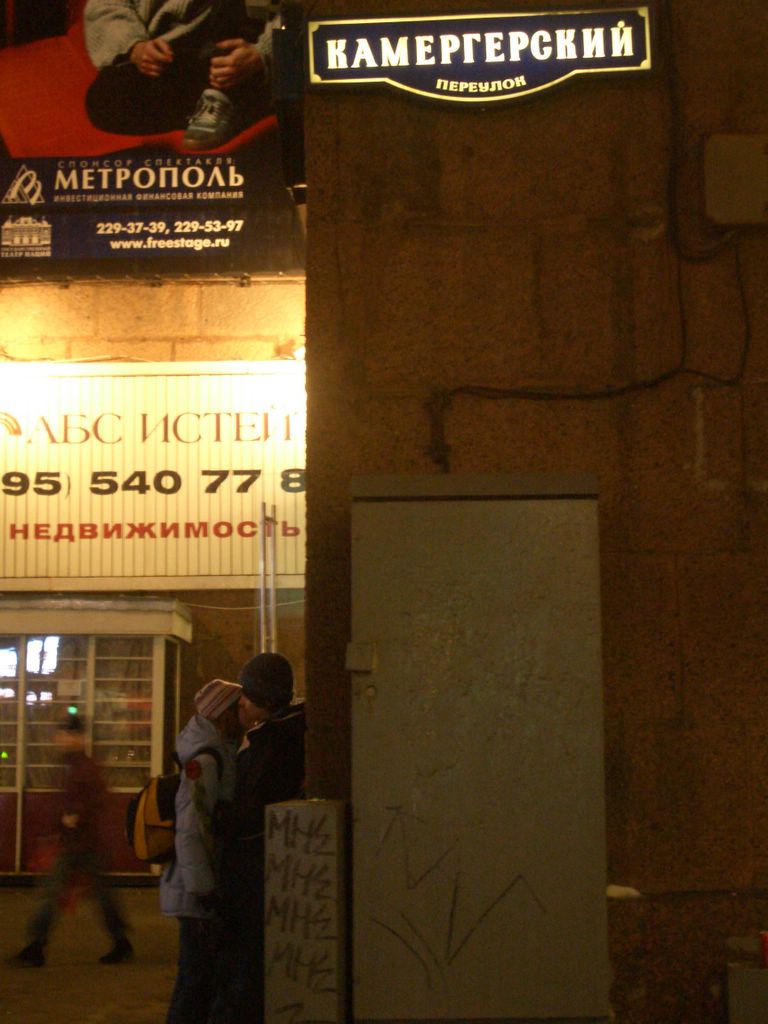
A young couple gets cozy near a utility box which sports the tag "Mne" repeatedly. "Mne" is the dative case of "I" (as in "me, myself, and I"), so it is used in constructions like "give it to me," or "Dai Mne," which happens to be the title of a much-hyped book
book by young Russian writer Irina Denezhkina - the recent English translation was titled Give Me, although I would have translated it as Give It to Me. Maybe that's why I'm not a professional translator. But I digress. In the graffiti context, Mne might just be an abbreviation for some 3-word phrase. KGM, for example (shown in an earlier post) actually stands for "Krasim Gorod Moskva," or "We Paint the City of Moscow." This scene is from the corner of Kamergersky Lane & Tverskaya, 9:14pm.


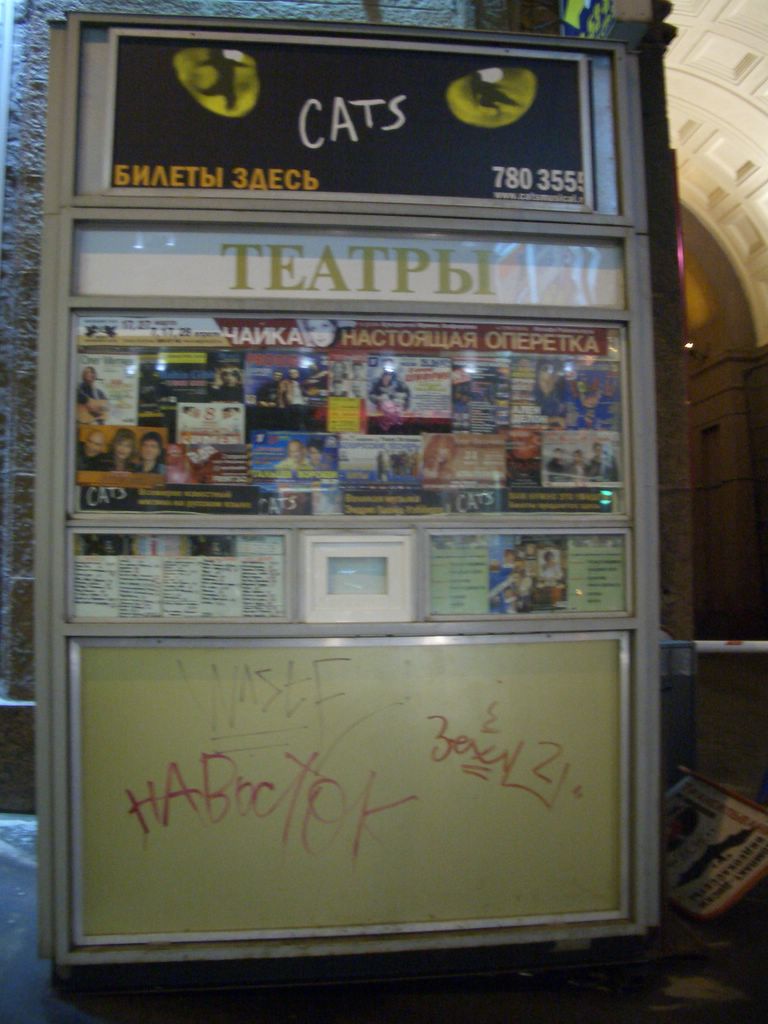
Tags - Waste, Na Vostok (this loosely translates as "Eastward" or "Toward the Orient"), and an illegible one - on a theater kiosk on Tverskaya (yes, "
Cats" has made it to Russia - it's even being performed in Russian), 10:06pm.


Ornate but illegible tag ("The [something]") on the shutter of a closed kiosk in the pedestrian underpass by the
book store at Tverskaya 8, 11:18pm.


Zachem tag on the other side of the same kiosk in the same underpass, 11:18pm.


Well-placed graffiti on the
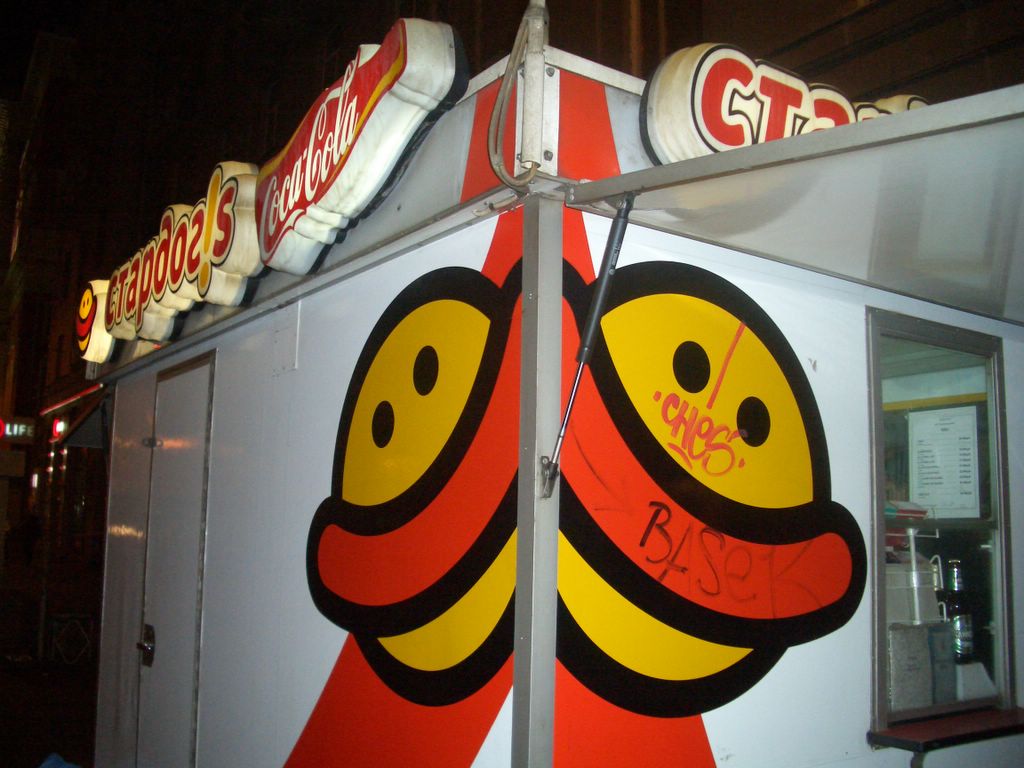
Stardogs stand (formerly a "Stop-top" stand, if you haven't been in Moscow in awhile - they rebranded all of them last year), across Tverskaya from the book store, 11:19pm.


A graffiti writer who goes by the handle "Waste" has helpfully labeled this trash can for English-speaking visitors to Moscow, on Tverskaya just toward the center from Pushkin Sq., 11:38pm.


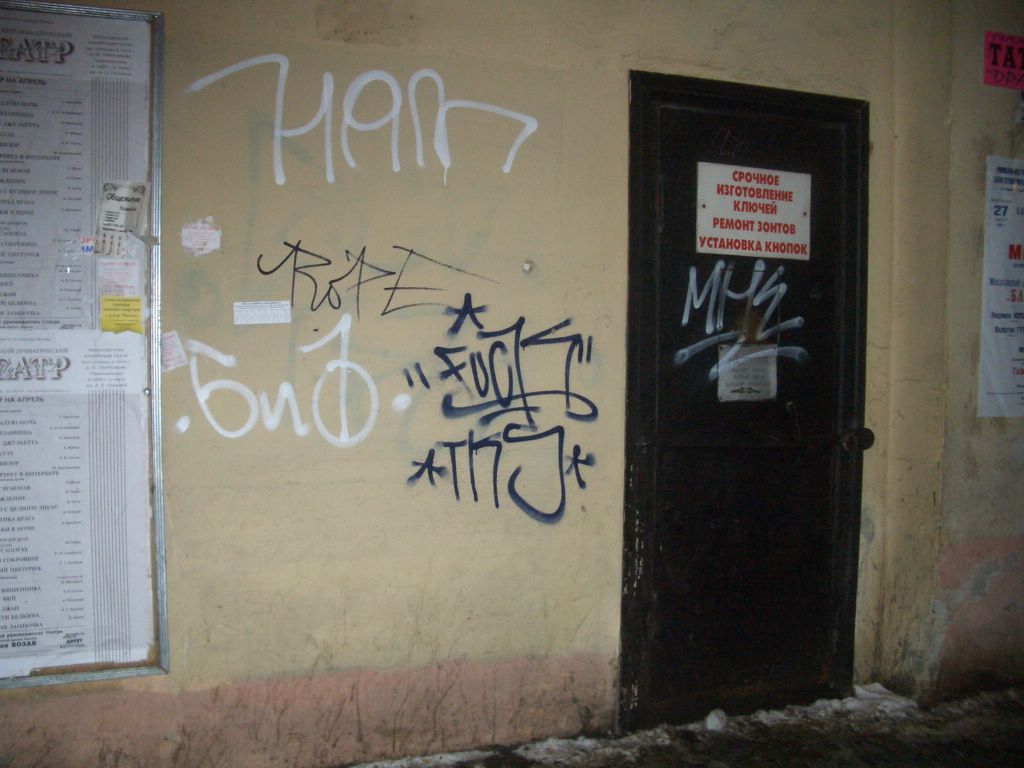
Various graffiti, including "Mne" on the door to a while-you-wait key shop, Maly Palashevsky Lane just off Tverskaya, 11:43pm. Yes, that is an obscene graffito right there in the middle. Apologies to English-speakers who are offended. As for the other tags, "Ham" (or perhaps "Nam," depending on whether you think the tagger was using the Latin or Cyrillic alphabet) is one I've seen around and have some photos of, but BiF is one I hadn't seen before this evening.


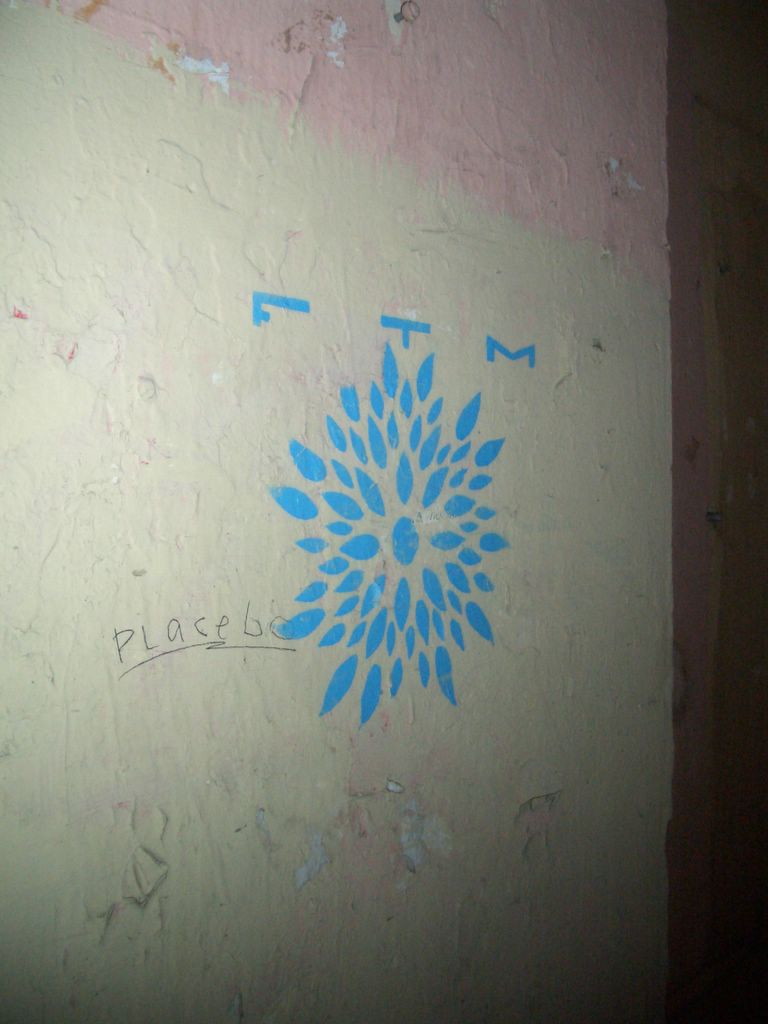
FTM ("For The Masses"?) stencil, Maly Palashevsky Lane just of Tverskaya, 11:45pm.

Wednesday, March 23, 2005

Shadowboxing; a post on commercial stencil graffiti

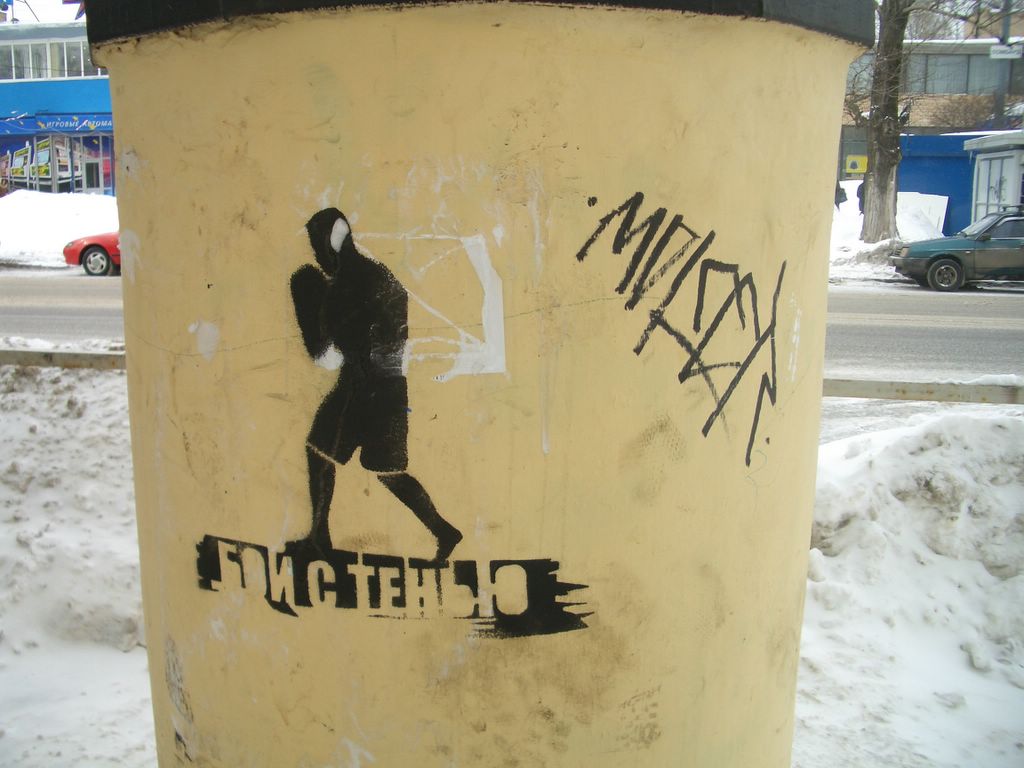
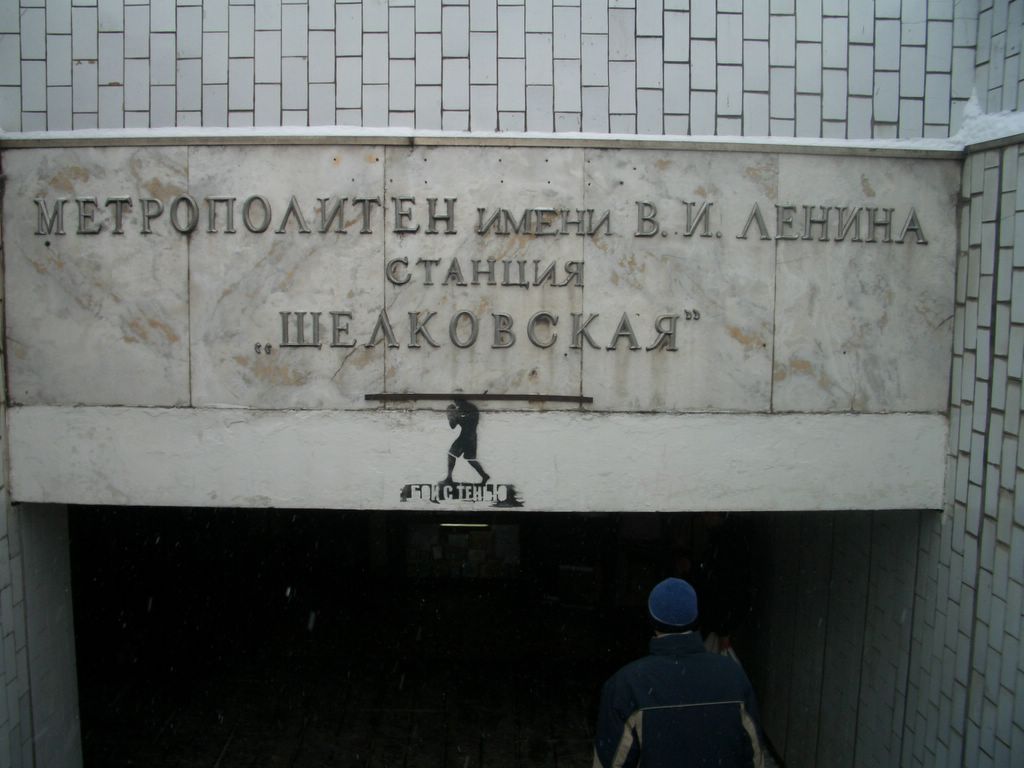
Using stencil graffiti as a medium for a commercial "guerilla marketing" campaign is nothing new, but it's not something you see every day in Moscow. So I was startled to see a cluster of identical stencils near the Shchyolkovskaya metro station, evidently promoting "Shadowboxing," a recently released Russian movie. The caption reads, "Бой с тенью," or "Shadowboxing."


11:21am, March 19.


Entrance to the Shchyolkovskaya station, 12:55pm, March 19.


12:55pm, March 19.


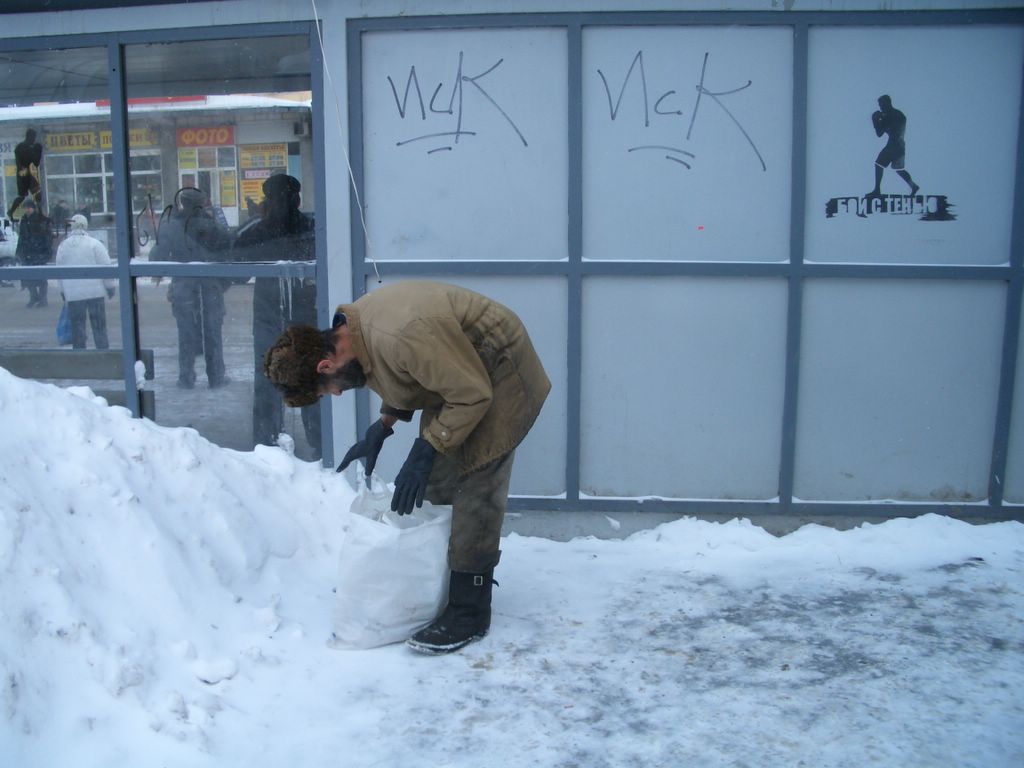
2 stencils - one at far left - on a bus stop shelter, along with two "Isk"
tags and a scavenger picking up a recyclable bottle, 12:57pm, March 19.


Shadowboxing with a pay phone, 12:58pm, March 19.

Using counterculture media to launch corporate, commerical ad campaigns is old hat in the West, and it's not a brand-new (so to speak) idea in Moscow, either. Below is a remnant of one such campaign from last year, when Adidas had these stickers all over the city - shortly before the official portion of the campaign, including trolleybuses painted with full-length versions of this sticker. I wonder if they did this in other cities?


"I [Adidas] Moscow" sticker on an outdoor ashtray/trash
can near the Voikovskoe metro station, 3:30pm, March 19.

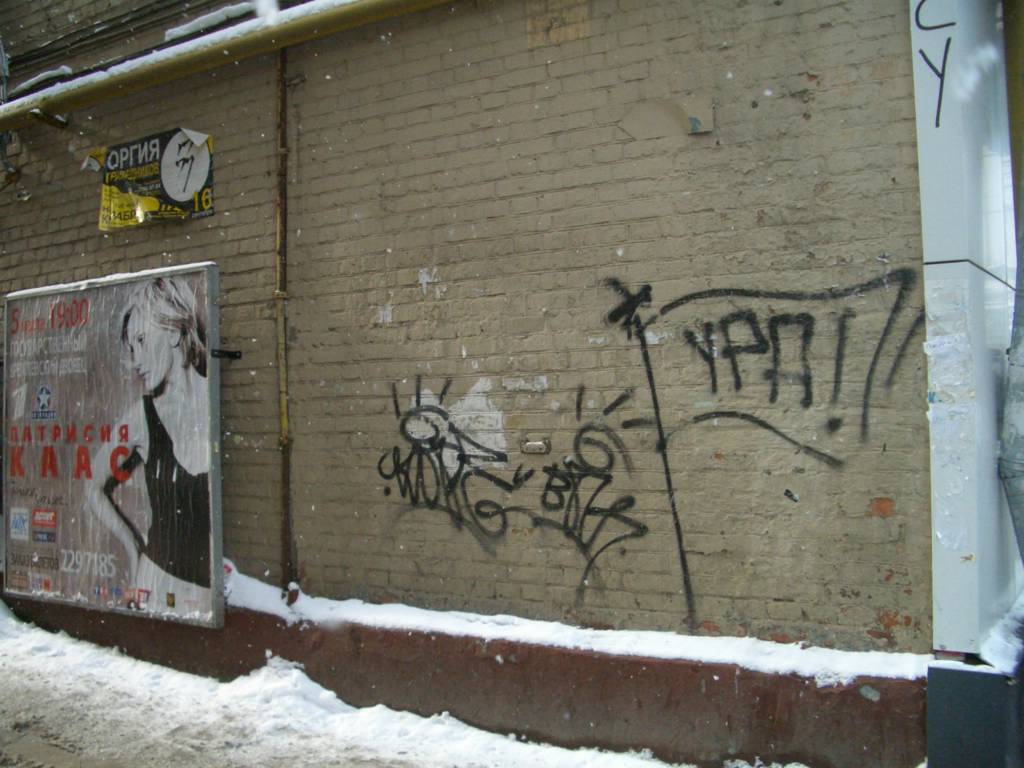
Hurrah!

The flag reads, URA! - in Russian, this means, Hurrah!

Not clear what was being cheered.


In an alleyway just off 2nd Brestskaya St., 3:05pm, March 10.

Sunday, March 20, 2005

Sick and the City

Veronica at Neeka's Backlog has a great photo of a bit of Moscow stencil graffiti which reads "sick and the city." Definitely worth checking out.

Saturday, March 19, 2005

Zachem! (Why!)

Zachem (From the Multitran online dictionary: зачем [phonetically: Zachem] нареч. why; wherefore; for what; what for?; whereto) is the most prolific writer in my neighborhood (downtown Moscow around Pushkin Square), but his reach extends far beyond that as well.

In an
earlier post on my other blog, Scraps of Moscow, I pontificated on the significance of this handle and noted that one could spend lots of time trying to track down all of the Zachem tags in my area. The photos below were all chance encounters with Zachem - I didn't seek the tag out, just happened to have a camera with me while out and about. The first 3 photos are from St. Petersburg (told you this guy gets around) and the rest are from Moscow:


Zachem among other graffiti in courtyard off #61 Liteiny,
SPB, Feb. 13, 12:53pm.


Zachem on Zhukovskogo St., SPB, 2:42pm, Feb. 13.


Zachem (atop a yellow sign directing people to a beauty salon) on
Zhukovskogo St. in SPB, 2:43pm, March 3.


Zachem on window on Tverskoi Bul'var, 8:38pm, Feb. 22.


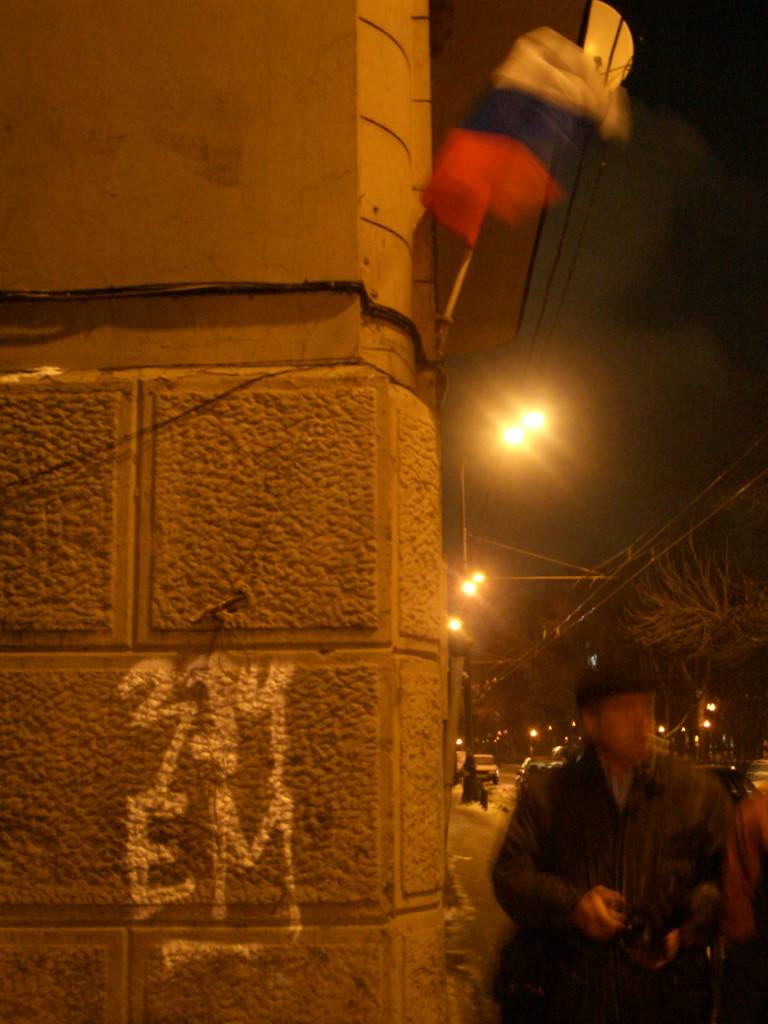
Zachem on wall with Russian flag flapping above, on
Tverskoi Bul'var, 8:35pm, Feb. 22.


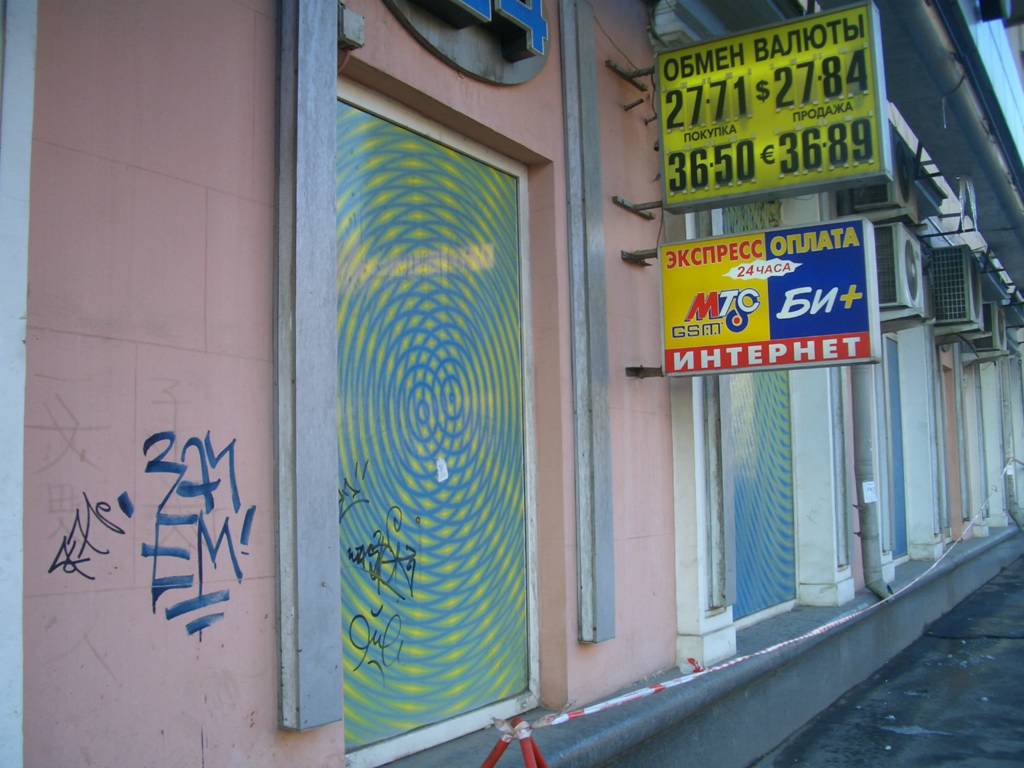
Zachem graffito next to grocery store window on Sadovo-Triumfal'naya St.,
4:31pm, Feb. 25.


Zachem on an abandoned building in the Patriarch's
Ponds area, 6:27pm, Feb. 26.


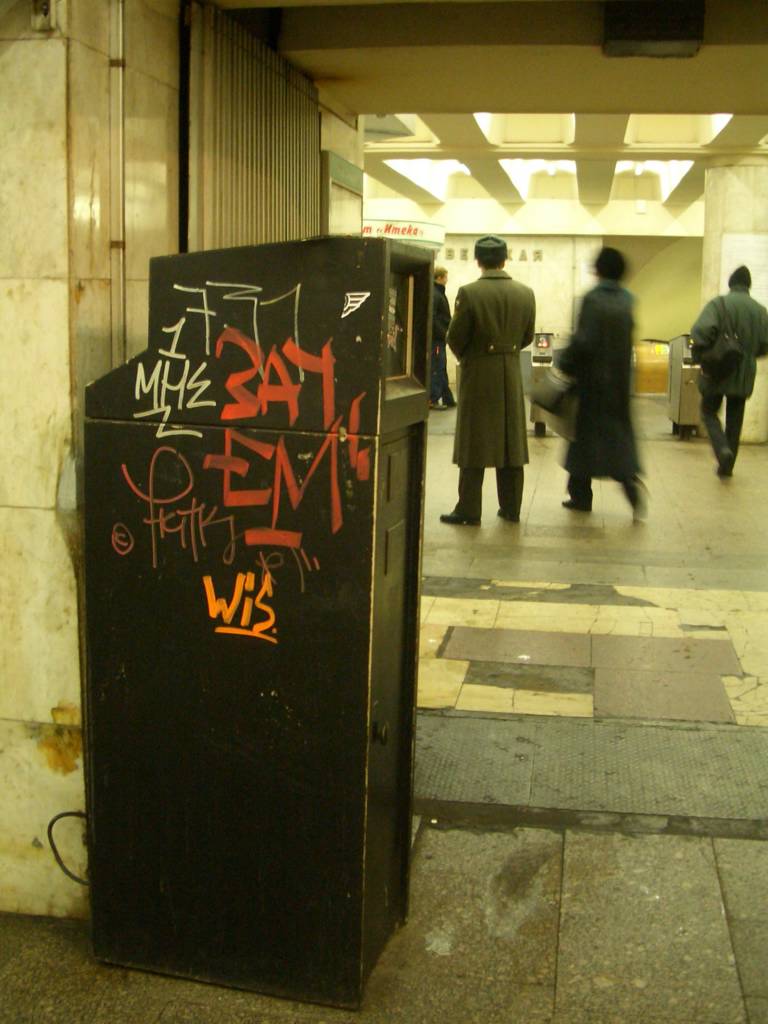
Zachem and others on an old ATM-type machine in the
entrance hall to the Tverskaya and Pushkinskaya
metro stations, 9:42am, Feb. 27.


Zachem in Maly Palashevsky Lane just off of Tverskaya
Street, 2:34pm, Feb. 27.


Zachem and others on store door on Tverskaya St., 9:59am,
March 2.


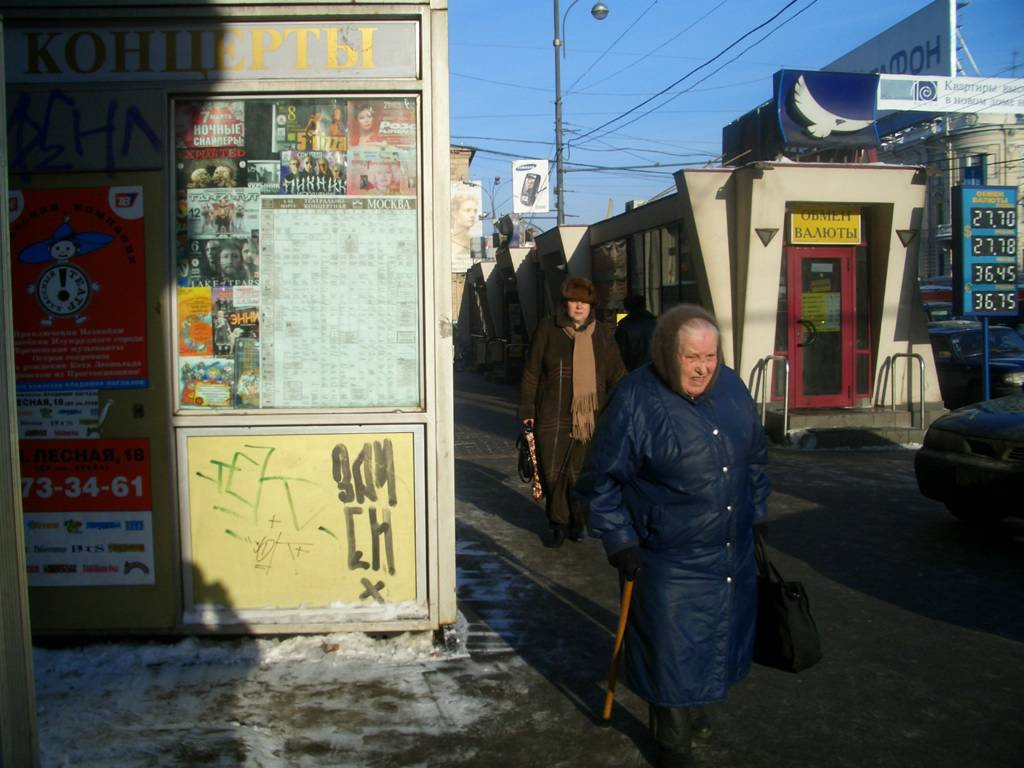
Zachem (in black - and a different script than usual) on a theater ticket
kiosk on Tverskaya St., 9:10am, March 4.


Zachem on netting surrounding a building undergoing
renovation at the corner of Rozhdestvenka and Kuznetsky
Most Sts., 5:17pm, March 6.


Zachem and others in one of the archways from Rozhdestvenka St. leading
to the entrance to the Kuznetsky Most metro station, 5:50pm, March 6.


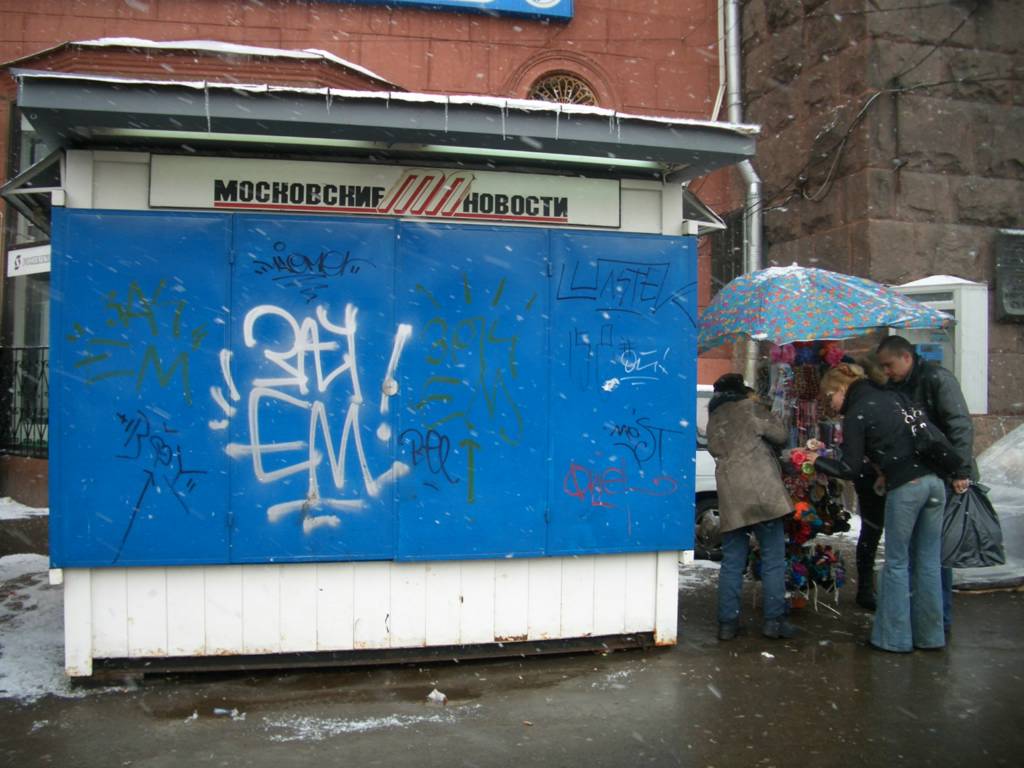
Zachem (multiple times) and others on the Moscow News kiosk on Pushkin
Square, 4:31pm, March 8.


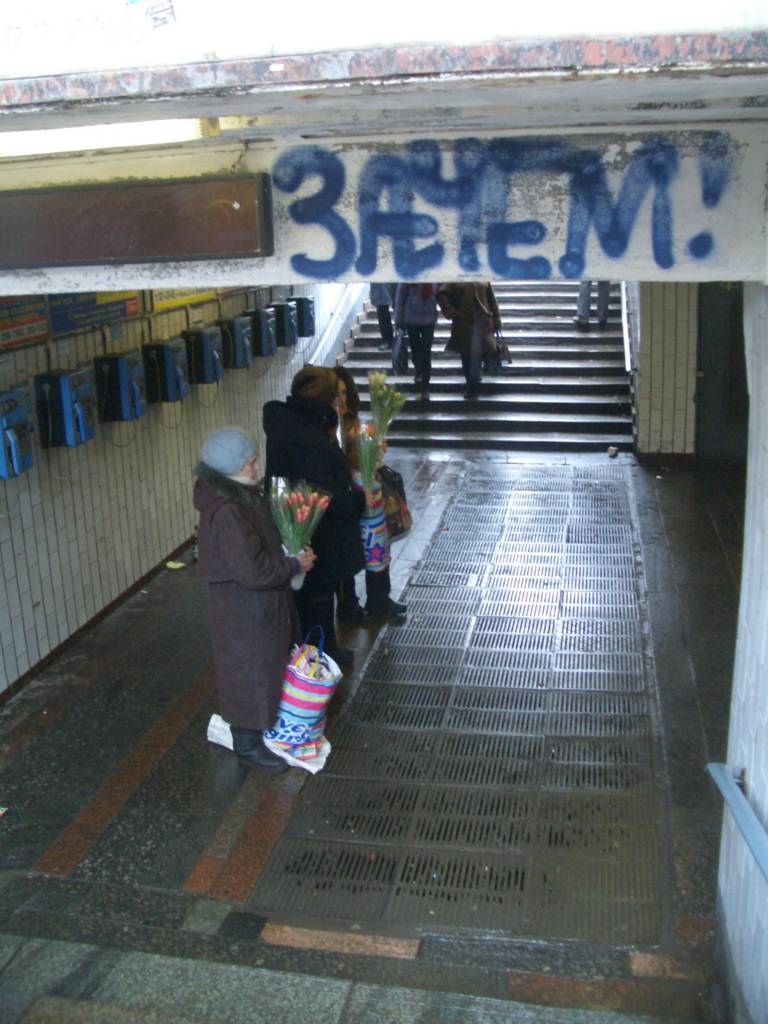
Zachem with Women's Day flower sellers, seen as one
descends the stairs into the underground passageway
underneath Pushkin Square, 5:01pm, March 8.

Note: all photos are from 2005; the first 3 are from St. Petersburg, and the rest are from Moscow.

Labels:

Friday, March 18, 2005

Lesnaya St.


Large piece on the side of a 4-storey building, Lesnaya
Street, 10:26am, March 12, 2005.

Bunny rabbit art

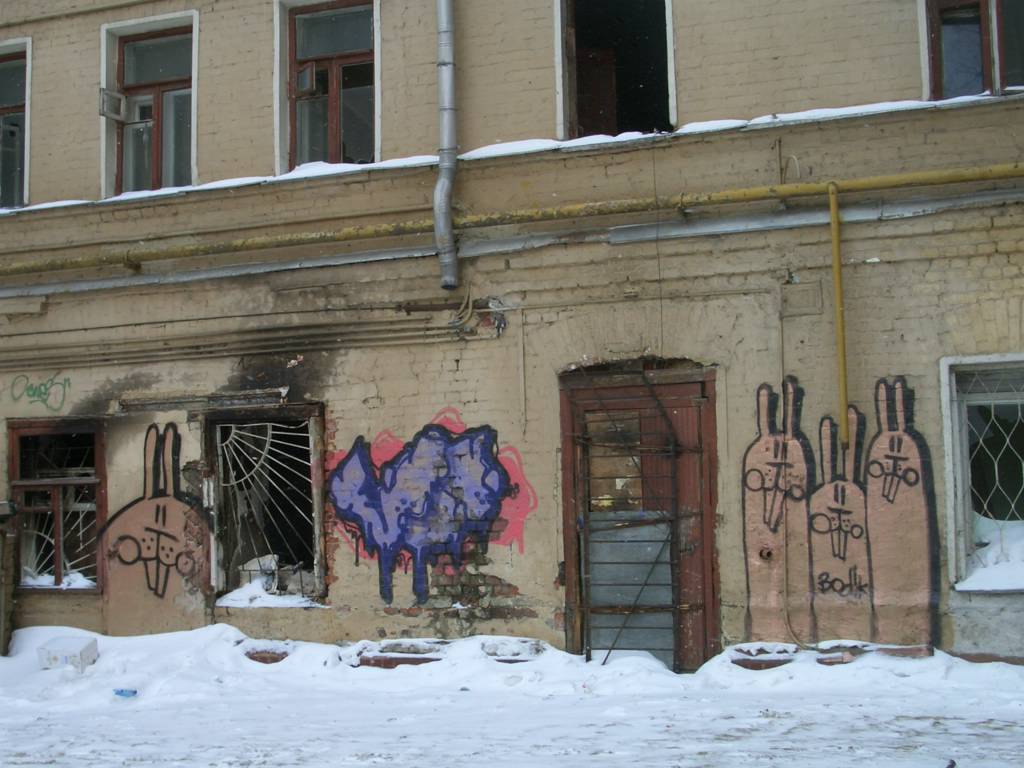
This requires no comment, except to mention that it definitely elevated our mood when we saw it and that it appeared on March 8th, International Women's Day:


Bunny graffiti (and something purple and less identifiable) on abandoned
building on the corner of 2nd Brestskaya and Gasheka Streets, 12:54pm, March 8, 2005.

Tuesday, March 15, 2005

From St. Petersburg

"Moscow Graffiti" is beginning to seem like a misnomer for this site, with all of the photos from St. Petersburg that I have been posting. These are left over from a couple of recent trips; hopefully I'll be up there again soon, as the writers there seem to be more creative and there are certainly more stencils I didn't get the chance to photograph. But I do have more Moscow material to come and will be publishing it in the next few days, time permitting. Anyway, here are some more street and courtyard scenes from SPB:


KGM tag (and passer-by's shadow) on Vosstaniia St.
near Moscow Station 2:17pm, March 3, 2005.


Tribute to glue ("klei"), a favorite way to get high for down-and-out
and/or homeless adolescents in Russia, 5:02pm, March 3, 2005, on the
Fontanka Canal Embankment.


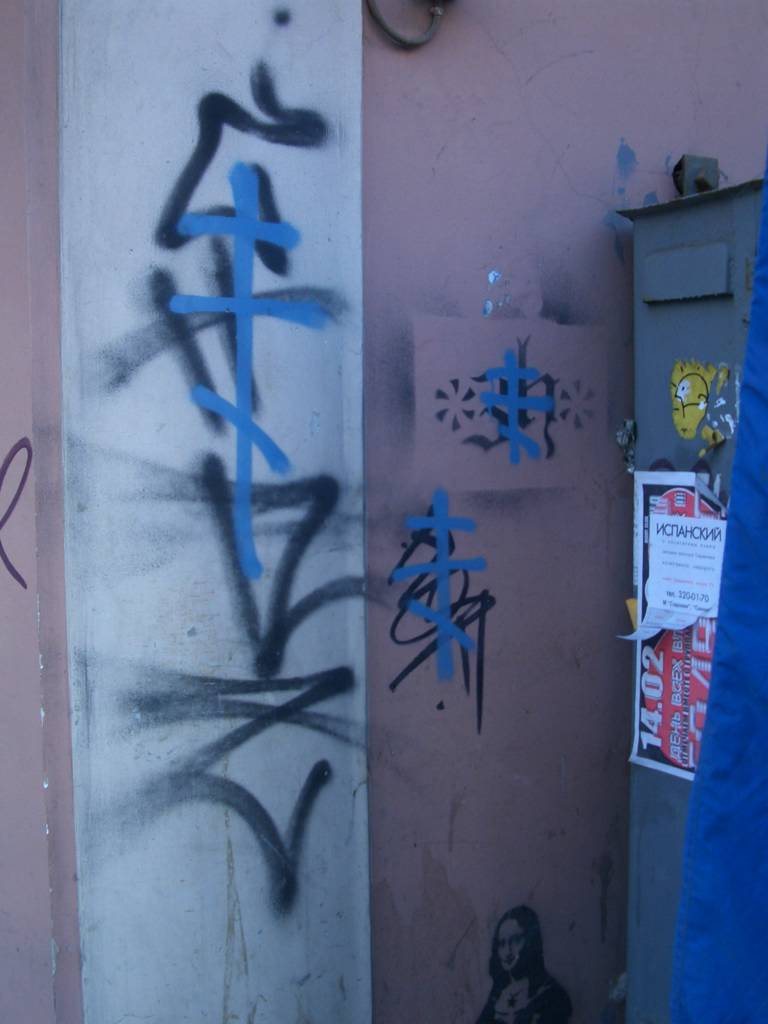
Graffiti crossed out by an apparently religious (that's
a Russian Orthodox cross in light blue) tagger activist,
seen on Nevsky Prospekt, 4:37pm, March 3, 2005. I saw
this same phenomenon elsewhere in SPB.


Graffiti on a wall in a courtyard off Zhukovskogo St., 1:53pm, March 3,
2005. Note at far right the "official" graffiti - a stenciled notice advising
people of the number to call to report a fire - and above it all a sign
advertising automobile window tinting.


My friend Bram surveying graffiti in a courtyard off
Liteiny Prospekt, 12:54pm, Feb. 13, 2005.


More graffiti in the same courtyard off Liteiny Prospekt,
12:54pm, Feb. 13, 2005. This courtyard can be reached by
entering the courtyard of #61 Liteiny, then proceeding
through another archway that houses the entrance to
an antiquarian bookstore (that's how I originally found
this place), which takes you into this small, triangular,
graffiti-ed to the hilt courtyard.

Monday, March 14, 2005

The metro as canvas

Sometimes graffiti can turn up in the most unexpected places:


"Waste" tag on metro escalator railing - I have seen tags on many Moscow
metro escalator railings.


"Sac" tag on metro turnstiles - in hot pink! - very creative placement.

Both photos taken at the Belorusskaya station (Lesnaya St. entrance) around 11am on March 12, 2005.

Blue line graffiti

The dark-blue line of the Moscow metro is one of the older lines, which means some of the downtown stations have the spectacular and grandiose design that the Moscow metro is known for. It also goes above ground closer to the end of the line, and there always seems to be graffiti along train rights-of-way.


"Isk" ("иск") graffito in the Ploshchad' Revoliutsii station (it may be
difficult to see since it was done with a narrow marker on the dark
background of the edge of the bench, toward the bottom of the photo in
the center). What I like about this tag is that while it's a word in Russian
that means "lawsuit," it's also the root of the verb iskat' (искать), which
means "to search or seek." What I like about this photo is the guy sleeping
on the next bench over.


Graffiti visible (on prefab garages, I think) from the blue line somewhere
past the Izmailovsky Park station.


This is a special train car designed, I assume, to do repairs on the metro
tracks. It was parked and snowed in at the small train yard which comes
after the Semyonovskaya station, actually between the Izmailovsky Park
and Izmailovskaya stations, to be exact. It had another cab at the other
end of the scaffolding, which had some less interesting graffiti on it. I
couldn't get the whole contraption in my viewfinder, unfortunately.

All photos from between 10:30am and 1:30pm, Feb. 19, 2005.

Stencil graffiti around the world

I have noticed lots of "stencil graffiti" in St. Petersburg and not nearly as much in Moscow, although maybe I'm just not looking in the right places.


"Graffiti Can't Be Stopped" stencil, 3:20pm,
Feb. 13, 2005, Zhukovskogo Street, St. Petersburg.


The caption on this reads (in translation): "I didn't go
to work today... ...I don't think I'll go tomorrow." Seen
on Zhukovskogo St. in St. Petersburg, 2:39pm, March 3, 2005.


The caption reads, "Be alert - you are being watched. Seen on a side street
(I can't remember which) off Nevsky Prospekt in St. Petersburg, 4:58pm,
March 3, 2005.


The Mona Lisa as a drunk - the caption reads, "Alko."
Seen on the corner of Nevsky Prospekt and a cross street
(can't recall which), 4:37pm, March 3, 2005.


The caption reads, "Get a hold of yourself" (literally, "Hold yourself in
your hands"). Seen in an archway off Zhukovskogo Street, 2:40pm, March 3, 2005.

I was considering the possibility that the English-language stencil I saw in St. Petersburg might be a result of Finnish artists coming down there (as Finns are wont to do to engage in all kinds of bad behavior), but that doesn't explain the ones in Russian.

I haven't seen any like them in Moscow - the only stencil graffiti I've seen there is without any apparent message.


The caption reads "Konyok," which has many meanings
(according to Multitran ), including one which
refers to a type of bird. Who knows what this symbol
really means. Seen on Kuznetsky Most St. in Moscow,
5:15pm, March 6, 2005.


Stencil graffiti in its broader context...

...and close up. A bar code intertwined with flowers. No doubt someone's
trying to say something with this. Seen on Tverskaya St. near Pushkin
Square in Moscow, 5:00pm, March 6, 2005.


This last one is from Washington, DC, my
hometown. The caption reads (in case you
don't want to click on and expand the picture)
"Our dreams cannot fit in their ballot boxes."
Seen at the corner of Albemarle and 43rd
(I think) Sts., Northwest, on January 15, 2005.

As it turns out, stencil graffiti is a phenomenon that the web already has covered - no surprise there, I guess. Googling that last phrase (about the dreams and ballot boxes) led me to a blog called Madison Art Crime Collective , which has a post with a similar stencil seen in Madison, Wisconsin (coincidentally, my father's hometown).

I especially liked that blog's
inaugural post, which seems to serve as a sort of mission statement as well as breaking down some of the differences between different graffiti styles for the uninitiated. An excerpt:
I am going to do my best to photo-document Madison art graffiti as much as possible (any and all submissions are welcome) so that it can be admired/ridiculed/etc. I am going to focus primarily on stencil graffiti, but I will let this blog develop as the art does. Two reason for singling out stencil graff: 1) unlike "tagging", the work tends to be more premeditated and concerned with both aesthetics and message.* 2) one year ago there was little, if any, stencil work to be found in Madison, but since this summer, shazam!There is change in the air and this forum is here to give it voice!

*a word to the taggers: I'm not trying to start a war here, there are truly amazing tagging works out there and they are all the more amazing for having been painstakingly hand done and out of sight of the popo's. However, they are usually in hard to reach/edge of town areas for the same reason. Also, there are far too many egoists who are running around scrawling their names on things without creating art. Art isn't about fame, it's the love baby, the love!
MACC led me in turn to the Milwaukee Stencil Graffiti Map Project - a website that's a bit hard to navigate but is an interesting concept - an interactive city map with photos of graffiti- and to the Stencil Revolution website, which has galleries of lots of stencil work, and also to the Wooster Collective website - "A Celebration of Street Art."

Wooster Collective in turn led me to a website called
Streetmeme , also focused on stencil graffiti. Getting away from the stencil focus, Wooster Collective also links to Streets Are Saying Things - "The original online graffiti museum."

I get the feeling that I'm just scratching the surface of the graffiti-themed material that's out there on the WWW.

Saturday, March 12, 2005

Coincidence? Or a sign of the times...

Tonight as I walked home from work and pondered the large number of photos of the work of Moscow and St. Petersburg taggers and graffiti artists that I have built up and want to share with people who may be interested in this sort of thing, I decided that the best way to do so would be to start a new blog.

My first project,
Scraps of Moscow, is nearly 5 months old and going strong, but I am trying to avoid clogging it with graffiti photos that have more of a niche appeal. I have put up several posts (here, here, and here) with photos and commentary on Moscow and St. Petersburg graffiti, but I have many more photos that I feel compelled to organize in blog form. Mainly this phenomenon interests me because it seems relatively new. Of course, there have always been people writing things on walls here as anywhere else, even in Soviet times, but only in the past year (or really more like the past six months) have tags started to crop up with substantial density on the walls of buildings (not just in courtyards, either - often on the street side) in downtown Moscow.

Anyway, I had decided to start this new project, mainly for myself, though hopefully it will find a small audience of people interested in these things, so imagine my surprise when I opened the Moscow Times to the weekend arts and entertainment section, "Context," and found a story about a soon-to-be-launched magazine focused on Moscow graffiti,
Code Red.

I guess I'm not the only one who has noticed the trend. To judge from the preview of the magazine provided on its website, the publication will focus on more advanced artwork than one generally comes across just walking around downtown - they clearly know the spots where the artists work - but I notice that they have at least one pic on the montage page of a "Zachem" tag. I have a whole portfolio of that tagger's work at this point, which is just one of the reasons why I felt the need to start this new project - as I have time, I will post photos from the archive I've already amassed, and of course I will seek out new tags and interesting street art as I have time to do so.

For the time being (as you wait for the first crop of photos), the Moscow Times article mentioned above can be read in its entirety below:
Street Spreads
The creators of Code Red, Russia's first professional-quality magazine devoted to graffiti, say their craft should be taken seriously.
By Brian Droitcour
March 11, 2005

Code Red, Russia's first professional-quality magazine devoted to graffiti, will bring the art of the streets to bookshelves. Besides allowing graffiti writers to review the work of their peers and idols, the magazine may also interest specialists in contemporary art, who are beginning to study graffiti more seriously, and corporate designers, who use graffiti-inspired motifs in marketing products to young audiences.

The magazine skimps on text but is generous with images, allowing its "readers" to draw their own conclusions. Most of the first issue's 68 pages are devoted to photographs of graffiti. Some spreads examine the work of a single graffiti writer, while others report on festivals, such as last August's "Meeting of Styles," which drew artists from Eastern Europe and Germany to Gomel, Belarus. Another spread, titled "Germany," presents the work of that country's best-known graffiti writers.

The virtual absence of text is designed to help Code Red reach an international audience. This goal is made clear on the first page, where the editors' introductory letter is printed in both English and Russian.

"Until recently, Russian graffiti hasn't been taken seriously abroad," Dmitry Krokhin, the magazine's editor, said Saturday. But Krokhin, who writes graffiti under the pseudonym Oskes with the collective Absurdmafia, believes graffiti in Russia has reached a level of sophistication near that in countries where graffiti has been practiced much longer. As proof, he points to the development of distinct schools of graffiti in Moscow and St. Petersburg. Krokhin said he prefers the St. Petersburg style, which is sprawling and chaotic, to the discrete elements and logo-like shapes common in Moscow.

Krokhin said that his European contacts have already displayed interest in Code Red, partly because it is superior in quality to the homemade "zines" that prevail among graffiti publications in the West. "Zines are things people make and distribute on their own money," he said. "Because the standard of living in Russia is different, you can't afford to spend that much time on something and not profit from it."
Besides appealing to their foreign peers, Code Red's creators hope to earn the respect of Russians who would normally pay little attention to graffiti. The editor's letter states that Code Red aims to "form an unbiased opinion about Russian graffiti, that it's not just a 'teenage pastime' (as most representatives of the media and ordinary people trained in the academic art tradition think), but a serious modern cultural trend.

"While graffiti writers may never get much respect from law enforcement officers charged with preventing vandalism, they are already getting attention from "the academy." Last weekend's release party of Code Red coincided with the final days of "Collaborators," an exhibition at the New Tretyakov Gallery that showed the work of Absurdmafia along with that of artists who have already been canonized as classics of contemporary Russian art, like painters Vitaly Komar and Alexander Melamid.

However, Andrei Yerofeyev, the main curator of "Collaborators," drew a line between graffiti and the kind of contemporary art typically found in galleries and museums. While graffiti is a significant influence on contemporary art, he said, its origins and practice have more in common with folk art. Yerofeyev compared graffiti to the African ceremonial masks that influenced Cubist painting and the drawings by children and the insane that fascinated the Surrealists. "Artists live in their reflections," Yerofeyev said. "Graffiti is something that people just do."

Graffiti writers like Krokhin distinguish their craft from contemporary art, as well as from commercial projects, which they also engage in. While Absurdmafia has participated in museum exhibitions and worked on corporate commissions, such as snowboard designs for Rossignol, Krokhin described these experiences as fundamentally different from creating street graffiti, where he is free to do whatever he pleases and any object is a potential canvas. "[Companies] pay me and I always work responsibly, regardless of whether or not I enjoy it," Krokhin wrote in an e-mail Wednesday. "For an exhibition in a museum, I'm working more for myself and can carry out my ideas as I planned."

The creators of Code Red hope to bring graffiti to a wide audience while preserving the spirit of the street. The magazine will be on sale in a number of locations that cater to free spirits, like the OGI chain of bookstore cafes and United Styles hip-hop stores.


All text and images Copyright © 2005-06 by author unless otherwise noted

eXTReMe Tracker

Who Links Here